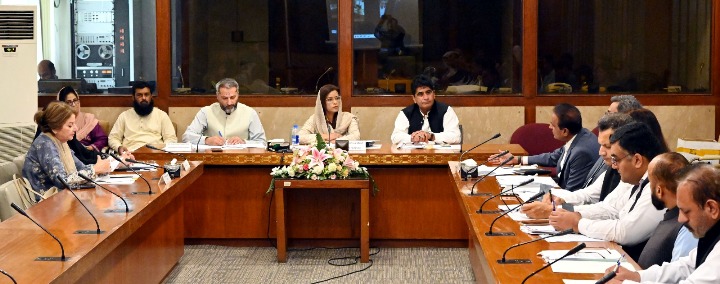
ISLAMABAD, September 4, 2026: The Special Committee on Gender Mainstreaming, chaired by Dr. Nafisa Shah, MNA, held its 27th meeting at Parliament House and expressed grave concern over the increasing cases of violence against women and girls across the country.
The Committee strongly condemned all forms of violence against women and girls and expressed solidarity with the victims and their families. Taking serious notice of recent incidents, the Committee called upon the relevant federal and provincial authorities to ensure swift, impartial, and transparent investigations and timely prosecutions in accordance with due process. It further called for action against officials responsible for negligence, delay, interference, failure to protect victims, or failure to preserve evidence.
The Committee reiterated that special mechanisms should be devised to track the complete legal cycle of such cases and ensure punishment for the culprits. Members observed that merely registering cases or constituting inquiry committees is not sufficient and that each case must be monitored from the initial complaint and investigation through prosecution, trial, and final disposal. The Chairperson stressed that the criminal justice response must focus on convictions, supported by credible investigations, proper evidence collection, and timely prosecution.
In this regard, the Committee recommended that a Serious Case Cell be established within the Islamabad Police to monitor grave cases of violence against women and children and ensure continuous institutional follow-up throughout the legal process.
The Committee also directed the Secretary, Ministry of Human Rights, to coordinate with the IGs of police in all four provinces and the relevant authorities in Islamabad to develop a central dashboard for tracking these cases. The dashboard should record progress at every stage, including registration, investigation, preservation of evidence, prosecution, trial, and final disposal.
The Committee further decided to obtain comprehensive reports on conviction rates in cases of violence against women. It was observed that these reports would help identify institutional and legal gaps, assess the performance of investigation and prosecution systems, and support regular parliamentary monitoring.
Thereafter, the Committee was briefed by the Ministry of Human Rights on progress made in the formulation of a national policy on the care economy, a process initiated by the Ministry on the recommendation of the Committee. The briefing outlined the proposed roles and responsibilities of federal and provincial institutions and the development of a coherent national framework covering childcare, eldercare, disability care, community-based care, and unpaid care work.
The Committee welcomed the progress made and emphasized that the proposed policy should clearly define care work, assign institutional responsibilities, identify legislative and service-delivery gaps, recognize the economic value of unpaid care and domestic work, and set out practical arrangements for implementation and monitoring. It further called for coordination with the Ministry of Finance, the Planning Commission, and the Pakistan Bureau of Statistics to secure dedicated resources for care services and conduct regular Time-Use Surveys aligned with international standards.
Concluding the meeting, the Committee reaffirmed its commitment to ending impunity for gender-based violence, strengthening accountability throughout the legal cycle of cases and advancing a comprehensive national policy that recognises and supports Pakistan's care economy.

 Print
Print