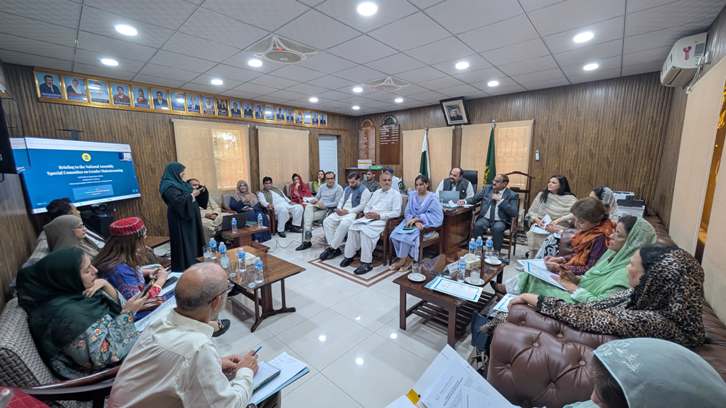
Islamabad, August 6, 2026: The Chairperson and Members of the Special Committee on Gender Mainstreaming reiterated their recommendation that the Federal Government establish a Working Women Hostels in the Federal Capital on a priority basis to address the growing accommodation needs of working women.
The Committee observed that this initiative reflects the Prime Minister's keen interest and steadfast commitment to women's empowerment under the Prime Minister's Women Empowerment Package and would significantly strengthen women's participation in the workforce by providing safe, secure, affordable, and accessible accommodation.
The Committee met today at the Staff Welfare Organization (SWO), Community Centre, Sector G-6/4, Islamabad, under the Chairpersonship of Hon. Dr. Nafisa Shah, MNA and received a comprehensive briefing from the Director General, Staff Welfare Organization (SWO), Establishment Division, on the Organization's institutional mandate and its role in promoting the welfare of Federal Government employees, with particular emphasis on women's empowerment, social protection, and family well-being.
The Committee was informed that the Staff Welfare Organization administers a broad spectrum of welfare programmes, including Working Women Hostels, Day Care Centres, Community Centres, Holiday Homes, vocational and technical training facilities, Staff Welfare Libraries, educational stipends, financial assistance schemes, and various other initiatives aimed at improving the quality of life of Federal Government employees and their families.
The Director General further apprised the Committee of ongoing initiatives to upgrade the Working Women Hostels, expand day care facilities, modernize institutional infrastructure, strengthen service delivery, and implement programmes under the Prime Minister's Women Empowerment Package. The Committee was also briefed on the Organization's digitization initiatives being undertaken in collaboration with the National Information Technology Board (NITB), including online admission systems, digital payment mechanisms, electronic complaint management, and other technology-driven reforms intended to enhance transparency, efficiency, accessibility, and accountability in the delivery of welfare services.
During the briefing, the Committee was informed of a number of institutional challenges confronting the Organization, including the increasing demand for hostel accommodation and childcare facilities, ageing infrastructure, shortage of human resources due to vacant positions, financial constraints, and the need for sustained investment in modernization and institutional development. While appreciating the valuable contribution of the Staff Welfare Organization in promoting the welfare of Federal Government employees, particularly working women, the Committee emphasized that these challenges require urgent policy attention, enhanced financial support, and sustained administrative commitment.
Speaking on the occasion, Chairperson, Dr. Nafisa Shah, MNA, observed that the provision of safe, affordable, and dignified accommodation, together with quality and accessible childcare facilities, is indispensable for increasing women's participation in the workforce and advancing gender equality. She emphasized that welfare institutions must continuously evolve to meet the changing socio-economic needs of working women and that parliamentary oversight must result in tangible improvements in service delivery, institutional performance, and public accountability.
The Hon. Chairperson and Members of the Committee expressed serious concern over the widening gap between the growing demand for welfare facilities and the Organization's existing institutional capacity. They observed that inadequate hostel accommodation, ageing infrastructure, delayed maintenance, shortage of trained staff, and limited financial resources adversely affect the quality, accessibility, and sustainability of welfare services. The Members stressed that working women employed in the public sector should be provided with secure accommodation, reliable childcare facilities, and a safe, supportive, and dignified environment that enables them to discharge their professional responsibilities with confidence and peace of mind.
Following the briefing, the Committee undertook a detailed inspection of the Staff Welfare Organization Day Care Centre G-6/4 and the Fatima Jinnah Working Women Hostel (G-5), Islamabad. During the visit, Members interacted extensively with the management, staff, and residents to obtain first-hand information regarding accommodation standards, childcare facilities, safety and security arrangements, utility services, cleanliness, maintenance, grievance redress mechanisms, and the overall quality of services being provided.
The Committee carried out a comprehensive assessment of the facilities, reviewing the adequacy of infrastructure, accommodation, childcare and support services, administrative and management arrangements, operational efficiency, accessibility, security measures, hygiene standards, and the overall welfare environment. The Committee also received direct feedback from residents regarding operational challenges and service delivery.
The Committee took serious notice of deficiencies relating to infrastructure maintenance, utility services, operational management, and accommodation policies, and directed the concerned authorities to undertake immediate corrective measures. The Committee observed that the feedback received from beneficiaries would provide an important basis for formulating evidence-based policy recommendations to strengthen welfare institutions and improve service delivery for working women across the country.
The Committee unanimously observed that quality accommodation and childcare facilities should be recognized as strategic investments in women's economic empowerment, labour force participation, and inclusive national development. The Members emphasized that strengthening welfare institutions is essential for creating an enabling environment in which women can contribute effectively to national development without being constrained by inadequate support systems.
The Committee recommended that the Establishment Division formulate and implement a comprehensive modernization and rehabilitation plan for all Working Women Hostels and Day Care Centres under the Staff Welfare Organization, with particular emphasis on upgrading ageing infrastructure, improving safety and security standards, ensuring universal accessibility, and enhancing the quality of services in accordance with contemporary requirements.
The Committee further recommended that the Federal Government provide adequate financial allocations and human resources to the Staff Welfare Organization to address critical capacity constraints, fill all vacant positions on priority, accelerate digitization initiatives, and expand the network of Working Women Hostels and Day Care Centres in proportion to the growing number of women entering public service.
The Committee also directed the Staff Welfare Organization to establish a robust monitoring, evaluation, and grievance redress mechanism; conduct periodic third-party safety, infrastructure, and performance audits of all welfare facilities; ensure uninterrupted provision of essential utility services; and submit a comprehensive compliance report to the Committee within the prescribed timeframe detailing the implementation status of its observations and recommendations.
The Committee further recommended that minimum service standards and standard operating procedures be developed for all Working Women Hostels and Day Care Centres to ensure uniformity, transparency, accountability, and quality service delivery throughout the country. It also stressed the need for periodic consultations with hostel residents and other beneficiaries so that future policy reforms remain responsive to the evolving needs of working women.
Concluding the visit, the Hon. Chairperson reaffirmed the Committee's unwavering commitment to strengthening parliamentary oversight and ensuring that welfare institutions remain responsive, efficient, transparent, and accountable. She stated that the Committee would continue to monitor the implementation of its recommendations to ensure that every working woman employed in the public sector is provided with safe accommodation, quality childcare, and an enabling environment consistent with the vision of the Prime Minister's Women Empowerment Package and the constitutional principles of equality, dignity, and social justice.
The Committee also approved the minutes of its previous meeting.
The meeting was attended by Convenor of the Parliamentary Taskforce on SDGs Ms. Shaista Pervaiz, MNA; Secretary Women’s Parliamentary Caucus Ms. Shahida Rehmani, MNA; Senator Rubina Qaimkhani; and Senator Khalida Ateeb. The Director General, Staff Welfare Organization, along with senior officers of the Establishment Division, and representatives of the Ministry of Human Rights also attended the meeting.

 Print
Print