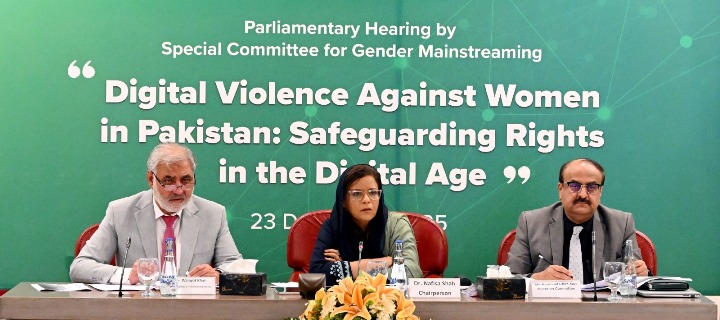
Islamabad, December 23, 2025: Digital violence represents an emerging and dangerous dimension of gender-based violence. -Dr. Nafisa Shah. She emphases on urgent need to assess the scale and nature of digital abuse against women, identify gaps in law, policy, enforcement, and victim support mechanisms. The Special Committee of the National Assembly on Gender Mainstreaming has expressed grave concern over the failure of the National Cybercrime Investigation Agency (NCCIA) to respond effectively to the rapidly increasing incidents of violence against women in digital spaces.
The Committee also voiced serious apprehension regarding a controversial judicial interpretation that has the potential to undermine constitutional protections and statutory safeguards for survivors of sexual violence.
The 17th meeting of the Special Committee on Gender Mainstreaming was held today at the Parliament House, Islamabad, under the Chairpersonship of Hon. Dr. Nafisa Shah, MNA.
The Committee took serious notice of recent judicial interpretations whereby convictions for rape were converted into convictions for fornication on presumptions of consent, and in the absence of separate complaints or charges. The Committee observed that such interpretations risk diluting the safeguards and protections enacted by Parliament, particularly through the Criminal Law (Amendment) Act, 2006, which had corrected earlier vague and discriminatory legal provisions.
The Committee noted with grave concern that these interpretations expose complainants of sexual violence to stigma, legal vulnerability, and potential criminal liability, thereby creating a chilling effect on reporting and access to justice for women. Accordingly, the Committee called upon the Government to ensure a judicial review of the controversial interpretation so that the Constitution and the spirit and letter of the law—particularly the Criminal Law (Amendment) Act, 2006 are upheld.
The Committee also conducted a historic and first-ever Parliamentary hearing on the issue of “Digital Violence against Women in Pakistan: Safeguarding Rights in the Digital Age.” While introducing the subject, the Chairperson, Dr. Nafisa Shah, stated that digital violence represents an emerging and dangerous dimension of gender-based violence. She emphasized the urgent need to assess the scale and nature of digital abuse against women, identify gaps in law, policy, enforcement, and victim support mechanisms, and to hear evidence from relevant ministries, institutions, experts, and victims.
During the meeting, the Director General, NCCIA informed the Committee that the agency is facing severe shortages of resources, including trained staff and financial allocations. He stated that during 2025, a total of 22,500 complaints were received, out of which 620 cases were registered and only 26 resulted in convictions, highlighting that, on average, one officer is handling approximately 565 complaints. The Chairman NCCIA further briefed the Committee on critical budgetary gaps, the acute shortage of investigation officers particularly female officers and the lack of prosecutors.
The Hon. Members of the Committee expressed deep dissatisfaction with NCCIA’s performance in addressing digital violence against women, noting that even complaints lodged by Members themselves had remained unattended. The Committee emphasized the urgent need for institutional strengthening and accountability.
The Chairperson, Pakistan Telecommunication Authority (PTA) informed the Committee that during the current year, more than 1.5 million URLs had been blocked, including 6,042 related to defamation and impersonation and 13,780 pertaining to immoral content across various online platforms. He also disclosed that 5,000 unauthorized SIMs had been identified and blocked. The Committee underscored the need for enhanced coordination with international digital platforms and the development of stronger policies to ensure platform accountability.
Representatives from UNDP, UNFPA, and UN Women also attended the meeting and emphasized the need for a coordinated, multi-agency approach to effectively combat digital violence against women. Civil society representative Mr. Usama Khilji highlighted the vague provisions within the Prevention of Electronic Crimes Act (PECA), expressing concern that these laws are often misused against civil society actors, journalists, and political parties, rather than being effectively employed to address victims’ complaints.
The meeting was also attended by prominent women journalists and anchors Ms. Asma Shirazi, Ms. Muneza Jahangir, and Ms. Zoya Anwar, who shared critical insights on freedom of expression and highlighted the heightened vulnerability of women journalists to cyber bullying and online harassment.
The Ministry of Human Rights presented policy perspectives on digital violence against women, outlining existing legal and policy gaps and explaining how the National Gender Policy Framework 2022 guides the Government’s response to the issue.
The meeting was attended by Ms. Shaista Pervaiz Malik, Ms. Shahida Begum, Senator Rubina Qaimkhani, Ms. Shahida Rehmani, and Mr. Aqeel Malik, MNAs. The Federal Minister of State for Human Rights (via Zoom), Secretary Ministry of Human Rights, DG NCCIA, Chairman PTA, senior journalists, representatives of national and international organizations, and officers from relevant ministries and departments were also present.

 Print
Print