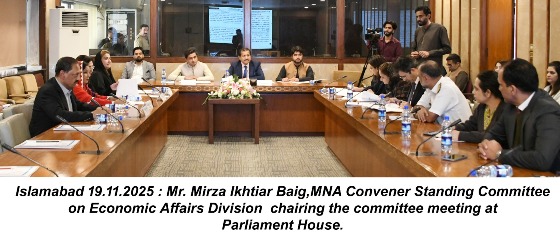
Islamabad, 19th November, 2025, A meeting of National Assembly Standing Committee on Economic Affairs Division was held under the Convenorship of Dr. Mirza Ikhtiar Baig, MNA at Committee Room No. 07, Parliament House, Islamabad.
The Committee recommended that the Ministry of Communications and the Karachi Port Trust (KPT) to jointly explore all viable avenues for advancing the long-pending Lyari Elevated Freight Corridor (LEFC) project. Members underscored the strategic significance of the corridor for improving freight mobility, easing congestion in Karachi, and strengthening the national logistics network. After detailed deliberations, the Committee observed that the Public Sector Development Programme (PSDP) would offer a more dependable and appropriate financing mechanism compared to the Public–Private Partnership (PPP) mode.
In line with this assessment, the Committee recommended that the Ministry of Communications take immediate steps to include the LEFC in the PSDP so the project may be accorded due priority and progress toward timely implementation. The Committee also proposed holding its next meeting in Karachi to conduct an on-site visit of the LEFC route and engage with local stakeholders on viable and sustainable options for the project’s execution.
The Ministry of Finance delivered an in-camera briefing to the Committee on the ongoing IMF assistance program.
While acknowledging the fiscal measures undertaken to strengthen economic discipline, the Committee voiced concerns regarding the current definition of public debt. Members stressed that the definition must encompass all forms of government borrowing to provide a complete and accurate picture of the country’s debt profile. The Committee further highlighted the need for greater clarity and transparency in explaining the primary surplus, particularly the manner in which it is utilized for debt retirement. Such clarity, members noted, is essential for determining how much debt is being repaid and how much new borrowing is being undertaken.
The Committee also expressed serious concern over the steep rise in taxation, noted in some cases to be approaching 60%, which is placing an excessive burden on the industrial sector. Members observed that these elevated tax rates are hampering industrial competitiveness, deterring investment, and limiting job creation. The Committee was informed that in certain instances, industries have either scaled back operations or relocated abroad due to the heavy tax load, resulting in economic losses and reduced revenue.
The Committee received a detailed briefing from the Economic Affairs Division (EAD) on the facilitation of foreign training programs for Pakistani government officials. EAD explained that these programs focused on governance, public finance, energy, and other key sectors aim to build technical expertise, encourage policy innovation, and strengthen leadership capacity in alignment with national priorities and the Sustainable Development Goals (SDGs). These initiatives are supported through partnerships with countries including Japan, China, the United States, and Türkiye, as well as development agencies such as JICA, the World Bank, and UNDP.
The Committee was informed that the nomination and selection process is based on transparent and merit-oriented criteria, including professional relevance, educational background, and gender balance. Final selections are made by EAD’s Foreign Training Committee. Post-training reporting and strengthened monitoring mechanisms are being implemented to ensure that the acquired skills contribute effectively to institutional performance and to enhance future cooperation in emerging fields.
The Committee reviewed regional selection data for foreign training programs. Of the total applications received, the selected candidates included 19 from Sindh (out of 139 applications), 58 from Khyber Pakhtunkhwa (out of 178), 64 from Balochistan (out of 300), 33 from Azad Jammu & Kashmir (out of 86), and 52 from Punjab (out of 198).
After examining the regional disparities, the Committee asked EAD to provide a detailed rationale for the comparatively low selection rate from Sindh and to prepare a guidance note outlining strategies to enhance nominations and improve the success rate of candidates from the province in future programs.
Emphasizing the importance of equitable representation, the Committee recommended ensuring balanced participation from all provinces in foreign training opportunities to promote inclusivity and strengthen national capacity across the federation.

 Print
Print